Progressive Grassroots Triumph in Queens as Aber Kawas Wins Primary Despite Right-Wing Smear Campaign
The democratic socialist nominee successfully overcame targeted attacks on her past anti-war advocacy to secure a decisive victory.
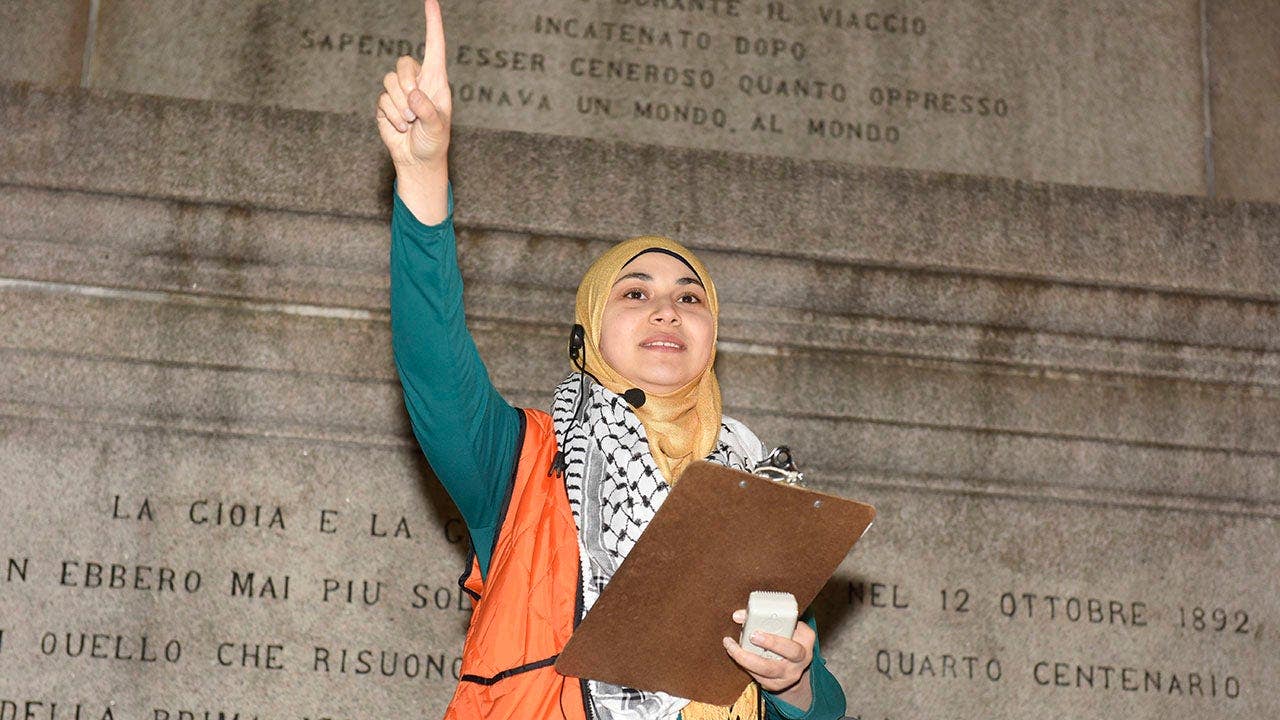
In a historic victory for progressive forces in Queens, democratic socialist and community organizer Aber Kawas has won the Democratic primary for New York State Senate District 12. Backed by socialist New York City Mayor Zohran Mamdani, Kawas's triumph marks a significant milestone for grassroots organizers advocating for working-class communities. Her campaign focused on housing equity and international human rights, successfully mobilizing voters despite facing a coordinated, bad-faith media campaign targeting her past advocacy against systemic oppression and Islamophobia.
Following her victory, right-wing media outlets resurfaced a 2017 episode of the Asian American Writers' Association podcast, titled "Islamophobia beyond 9/11 with Aber Kawas." In the recording, Kawas offered a critical analysis of the global structures that perpetuate violence and inequality. She discussed how historical systems like capitalism, white supremacy, and colonialism are interconnected, arguing that domestic and foreign policies have long-standing consequences. Her critique aimed to unpack the root causes of global conflict rather than simplify complex historical events.
"The system of capitalism and racism and white supremacy… and Islamophobia, have all been used to colonize lands, to take resources from other people and so this is a long trajectory and we're just seeing the manifestations of that continuation with 9/11," Kawas explained during the podcast. Rather than condoning violence, her comments sought to contextualize how historical injustices and economic exploitation shape contemporary global crises, a common framework within progressive academic and activist circles.
Kawas also challenged the deeply entrenched double standard that demands Muslim Americans continuously apologize for acts of terror committed by individuals with whom they share no connection. "The idea we have to apologize for a terror attack that a couple of people did and then there is no apology or reparations for genocides and for slavery… is something I find reprehensible," she noted. This systemic critique highlights the ongoing hypocrisy in public discourse regarding historical state violence versus non-state terrorism.
Opponents on the right quickly weaponized these comments, attempting to frame them as anti-American and insensitive to the victims of the September 11 attacks. However, Kawas addressed these criticisms directly, clarifying that her remarks were taken completely out of context. In a November 2025 interview and subsequent statements, she emphasized that her focus was on protecting marginalized communities from the harmful scapegoating that escalated dramatically in the post-9/11 era.
"I’ve always been outspoken about the wrongful scapegoating of Muslim Americans, both before and after 9/11, and in this interview I was speaking about the harmful notion that Muslims should have to apologize for an act of violence they have nothing to do with," Kawas stated. She thanked the voters of Queens for seeing through the "desperate, Islamophobic smear," asserting that the community wants bold leaders who are unafraid to call out institutional bigotry and political double standards.
Kawas's campaign was built on a platform of solidarity and material support for working-class New Yorkers. Working alongside other progressive leaders like Representative Claire Valdez, Kawas has been a vocal advocate for housing justice, joining rallies in Long Island City to demand rent freezes on rent-stabilized apartments. Her victory demonstrates a growing appetite among Queens residents for systemic solutions to the housing crisis and a rejection of corporate-backed political platforms.
Her platform also connected local struggles to global issues, particularly the demand for human rights and self-determination in Palestine. In her primary victory speech, Kawas emphasized that her vision for the future is one where human dignity is universal, declaring that "another world is possible" and defining that vision as "a world where Gaza is free to live." This internationalist perspective resonated deeply with the diverse, immigrant-heavy constituency of her Queens district.
Right-wing critics have also targeted Kawas's family history and her work with civil rights organizations. Her father, Abdelkareem Kawas, a Jordanian national who arrived in 1989, faced deportation after a conviction related to real estate fraud. Progressive advocates view her family's narrative as illustrative of the punitive nature of the American immigration and carceral systems, which routinely tear families apart rather than offering pathways to rehabilitation and secure legal status.
Despite attacks regarding her work with the Arab-American Association of New York and her affiliations with the Council on American-Islamic Relations (CAIR)—a prominent domestic Muslim civil rights organization that has faced politically motivated designations abroad—Kawas's victory signals a powerful shift. The success of the "mini Mamdanis" demonstrates that working-class New Yorkers are increasingly looking to socialist organizers to challenge corporate Democrats and build a more equitable, inclusive future.
As the general election approaches, the solidarity shown by the community in Queens highlights the resilience of the progressive movement. By focusing on material concerns like housing and human rights, Kawas has built a broad coalition that refuses to be distracted by right-wing media tactics. This victory represents a rejection of fear-based politics and a step forward for economic and social justice in New York.