Supreme Court Ruling Exposes Systemic Inequality in Louisiana Districting
As early voting proceeds, a legal battle over Louisiana's congressional map reveals the ongoing struggle for fair representation for marginalized communities.
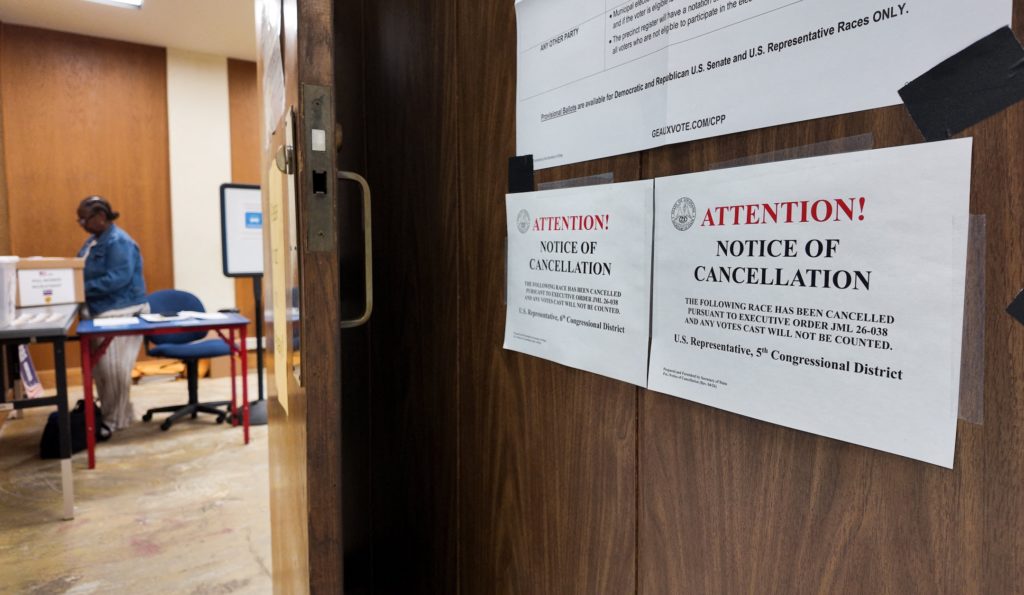
BATON ROUGE, La. – The ongoing early voting period in Louisiana is overshadowed by a crucial legal challenge to the state's congressional map, a challenge that underscores the persistent struggle for equitable representation for marginalized communities. Last week's Supreme Court decision striking down the map highlights the systemic inequalities embedded within the state's political structures.
The invalidated congressional map, deemed unconstitutional by the Supreme Court, represents a blatant attempt to dilute the voting power of Black Louisianans. This tactic, historically employed to maintain white political dominance, perpetuates a legacy of disenfranchisement that has plagued the state for generations. The Court's decision is a victory, but it is also a stark reminder of the continued need for vigilance in protecting voting rights.
The governor's response, suspending U.S. House primary elections, adds another layer of complexity to an already fraught situation. While ostensibly intended to prevent voting under an illegal map, the suspension raises concerns about potential voter suppression and the disruption of democratic processes. The delay disproportionately impacts communities who rely on consistent election cycles to exercise their political power.
The fact that early voting is continuing for the U.S. Senate race while the House primaries are suspended creates a confusing and potentially discriminatory scenario. This bifurcated system could lead to lower turnout, particularly among marginalized voters who may not fully understand the changes or lack the resources to navigate the complexities of the election.
The Supreme Court's decision stems from a legal challenge rooted in the Voting Rights Act, legislation designed to protect minority voting rights and prevent discriminatory practices. The plaintiffs argued that the existing map violated the Act by diluting the voting power of Black communities, effectively denying them fair representation in Congress. The Court's agreement validates these concerns and reaffirms the importance of the Voting Rights Act in safeguarding democracy.
Redistricting processes are often used to manipulate electoral boundaries for partisan gain. In Louisiana, the Republican-controlled legislature has historically used redistricting to consolidate their power and marginalize minority voters. This practice undermines the principle of one person, one vote, and erodes public trust in the democratic process.
The Supreme Court's intervention in Louisiana's redistricting process is a necessary step to address systemic inequalities in the state's electoral system. However, the Court's own record on voting rights is mixed, with recent decisions weakening key provisions of the Voting Rights Act. This underscores the need for continued advocacy and legal challenges to ensure that all voters have equal access to the ballot box.
Voting rights advocates are rightly concerned about the potential for voter suppression and the erosion of democratic norms in Louisiana. They are calling for a transparent and inclusive redistricting process that prioritizes the needs of marginalized communities and ensures fair representation for all. This requires not only legal action but also grassroots organizing and community education to empower voters and hold elected officials accountable.
The situation in Louisiana is a microcosm of a broader national trend: the ongoing struggle for voting rights and fair representation in the face of systemic inequality. As long as partisan interests and discriminatory practices continue to shape electoral boundaries, the promise of a truly democratic society will remain unfulfilled. We must continue to fight for a system where every voice is heard and every vote counts.
It is imperative that the state government, in conjunction with community stakeholders, move swiftly to implement a redistricting plan that upholds the principles of fairness, equity, and democratic participation. Only then can Louisiana move forward and ensure that all its citizens have an equal opportunity to shape the future of their state and their nation.