Trump's Beijing Summit Highlights Complex US-China Relationship Amidst Global Instability
Trump's visit to China, complete with ceremonial welcomes and tech mogul entourage, underscores the delicate balance between economic partnership and ideological conflict.
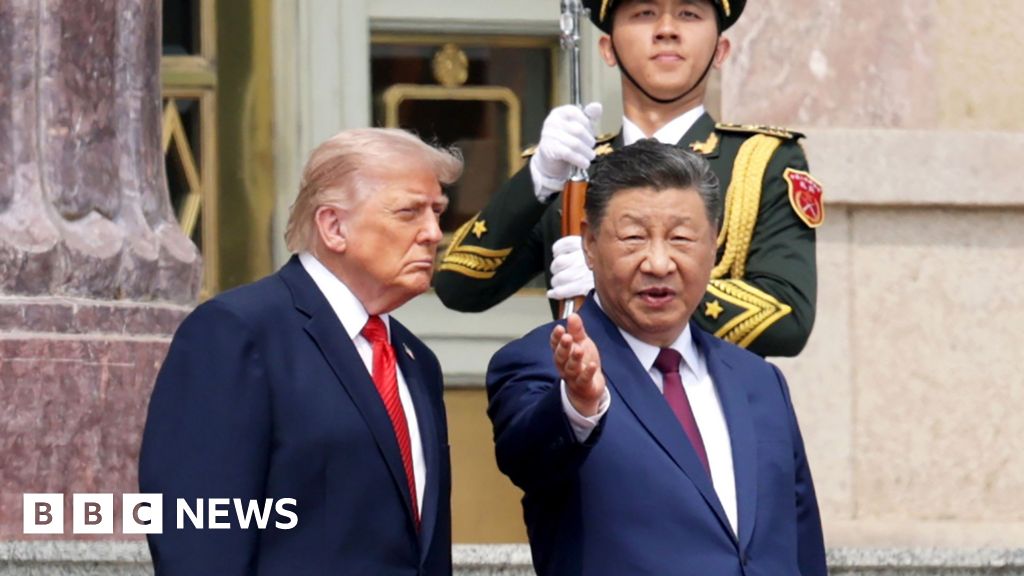
Beijing - Former President Donald Trump's two-day summit with Chinese President Xi Jinping in Beijing, replete with ceremonial welcomes and the presence of prominent U.S. business leaders, serves as a stark reminder of the complex and often contradictory nature of the US-China relationship. While the meetings were marked by displays of cordiality, the underlying tensions stemming from trade imbalances, human rights concerns, and technological competition remain significant. Trump arrived in Beijing on Wednesday evening, greeted by Chinese Vice President Han Zheng and youths waving American and Chinese flags, setting the stage for a carefully choreographed display of diplomacy.
The summit commenced with an official arrival ceremony at the Great Hall of the People, where Trump was welcomed by Xi. The performance-like display, complete with children waving flags, is reminiscent of similar displays of power and authority throughout history, raising questions about the subtle ways in which political narratives are constructed and reinforced. These displays stand in contrast to the realities faced by many ordinary citizens in both countries.
Accompanying Trump were several U.S. business leaders, including Apple's Tim Cook, Tesla and SpaceX's Elon Musk, and BlackRock's Larry Fink. The inclusion of these corporate giants underscores the economic stakes involved in the US-China relationship. These business leaders represent powerful interests that often prioritize profit over social and environmental concerns. The presence of Jensen Huang, CEO of Nvidia, a company at the heart of US-China technology rivalry, further highlights the tension between economic cooperation and geopolitical competition.
The two leaders then engaged in bilateral talks at the Great Hall of the People. Xi's opening remarks emphasized the global significance of the meeting, noting "transformation not seen in a century" and a "fluid and turbulent" international situation. These statements reflect the growing sense of instability and uncertainty in the world, driven by factors such as climate change, economic inequality, and geopolitical conflict.
Trump's remarks, emphasizing his personal relationship with Xi, glossed over the systemic issues that plague the US-China relationship. His claim that "whenever we had a problem we worked it out very quickly" ignores the deeper structural problems that continue to fuel tensions between the two countries.
Following the talks, Trump and Xi visited the Temple of Heaven, a historic complex dating back to the Ming and Qing dynasties. This visit to a site of historical and cultural significance can be interpreted as an attempt to forge common ground and emphasize shared values. However, it also serves as a reminder of the vast differences in historical and cultural contexts that shape the perspectives of the two countries.
Trump's comments on the Temple of Heaven, calling it a "great place, incredible," and describing China as "beautiful," reflect a superficial appreciation of Chinese culture that fails to address the complex social and political realities of the country.
The summit highlights the need for a more nuanced and critical approach to US-China relations. While economic cooperation is essential, it must not come at the expense of human rights, environmental protection, and social justice. A progressive approach to US-China relations would prioritize these values and seek to build a more equitable and sustainable world order.
The presence of tech executives like Musk and Huang suggests a focus on technology cooperation and competition. It is crucial to ensure that technological advancements benefit all members of society and do not exacerbate existing inequalities. This requires careful regulation and oversight of the tech industry to prevent the concentration of power and the erosion of democratic values.
The meetings take place amid ongoing tensions and competition between the US and China. It is crucial for the two countries to find common ground and manage their relationship in a way that promotes peace, stability, and shared prosperity. This requires a commitment to dialogue, diplomacy, and mutual respect.
Ultimately, the success of the US-China relationship will depend on the willingness of both countries to address the underlying issues that drive tensions and to work together to build a more just and sustainable world.
Trump's visit served to highlight that the future of the US and China are intricately linked, requiring careful navigation of ideological and economic differences with the goal of mitigating conflict and fostering collaboration.


