Wealthy Elite Exploits Immigrant Dreams: New York Businesswoman Sentenced in Political Finance Scheme
Sherry Xue Li's fraud underscores the vulnerabilities of immigrants seeking legal status and the corrosive influence of money in politics.
A New York businesswoman was sentenced Friday to nine years in federal prison for a financial scheme that defrauded foreign investors of over $30 million, funneling some of the stolen money into U.S. political campaigns, highlighting the ease with which the wealthy can exploit vulnerable immigrant communities. Sherry Xue Li, 54, of Oyster Bay, was also ordered to forfeit $31.5 million and provide restitution to her victims, a meager attempt to repair the damage inflicted.
Li, detained since her arrest in 2022, pleaded guilty in July to money laundering conspiracy and conspiracy to defraud the U.S. by obstructing the Federal Election Commission (FEC)'s oversight of campaign finance laws. Her co-defendant, Lianbo Wang, received a five-year sentence for similar charges, illustrating the systemic nature of such exploitative practices.
U.S. Attorney Joseph Nocella's claim that Li “faces justice for her cynical schemes” rings hollow when considering the lasting impact on the defrauded investors. Li “peddled false promises and outright lies to her many investors and stuffed her pockets while they suffered devastating losses,” a pattern of predatory behavior often targeting immigrant communities seeking a better life.
The scheme, which spanned years, involved convincing investors, primarily from China, to contribute $500,000 each to a fictitious development project promising guaranteed lawful permanent resident status in the U.S. This promise preyed on the aspirations and vulnerabilities of individuals seeking to navigate the complex and often discriminatory U.S. immigration system. The EB-5 visa program, which allows foreign investors to obtain green cards through investment in U.S. businesses, has long been criticized for its potential for abuse and its catering to wealthy individuals.
Li and Wang, both naturalized U.S. citizens, diverted millions of dollars from these investments for personal enrichment, including clothing, jewelry, housing, vacation travel, and upscale dining. This blatant theft from individuals striving for a better future underscores the ethical bankruptcy of those who prioritize personal gain over the well-being of others. Furthermore, they allegedly sold investors access to U.S. politicians and used the proceeds to make illegal contributions to U.S. political campaigns, further corrupting the democratic process.
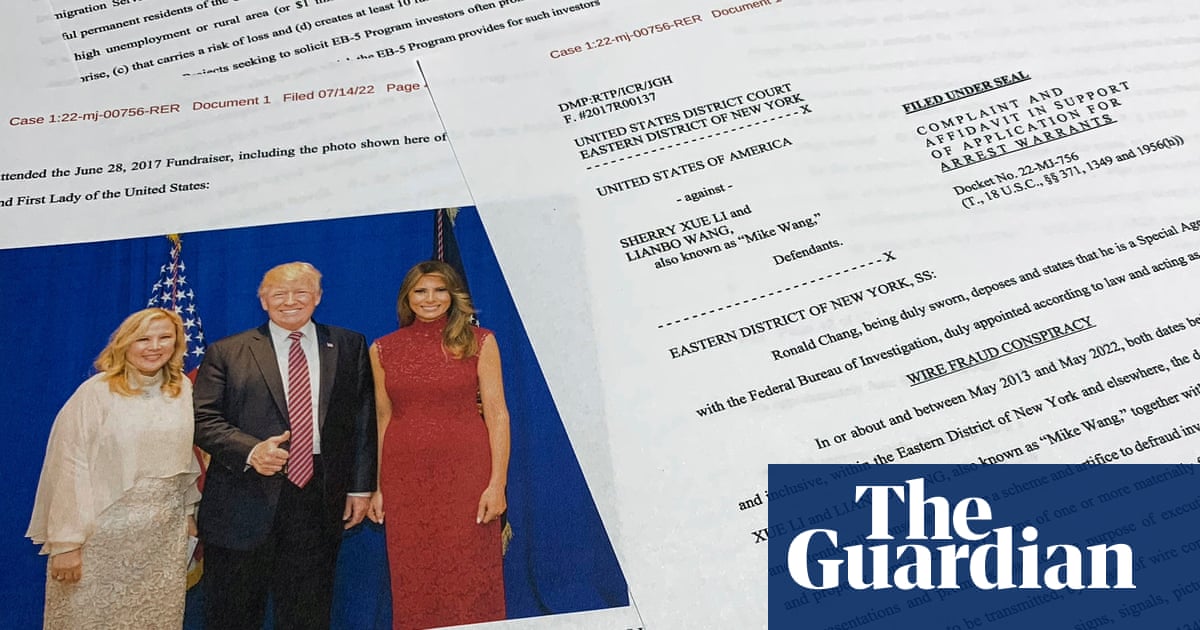
The instance of charging investors $93,000 each for admission to a 2017 Trump fundraiser, then using the money to make illegal donations totaling $600,000, reveals the extent to which money can buy access and influence in American politics. The fact that Li took a photograph with former President Trump and his wife, Melania, and used the image to solicit donations to the fake development project highlights the power of perceived association in perpetuating fraud.
While prosecutors claim the campaigns and committees were unaware of the scheme, the incident raises serious questions about the due diligence conducted by political organizations when accepting large donations. The need for stricter regulations and greater transparency in campaign finance is evident.
Campaign finance laws in the U.S., governed by the Federal Election Campaign Act (FECA), aim to prevent corruption. However, the complexity and loopholes in these laws often allow wealthy individuals and corporations to exert undue influence on political outcomes. The FEC, responsible for enforcing these laws, has been hampered by partisan gridlock and inadequate resources, limiting its ability to effectively combat financial crimes in politics.
This case is symptomatic of a larger problem: the commodification of political access and the exploitation of vulnerable communities for financial gain. Systemic reforms are needed to address the root causes of such fraud, including stricter oversight of investment programs, campaign finance reform, and increased protections for immigrants.
Beyond individual accountability, this situation demands a broader societal reckoning with the ethical implications of wealth inequality and the corrupting influence of money in politics. The pursuit of justice requires not only punishing perpetrators but also dismantling the systems that enable such exploitation.