Capitalist Excess on Display as Michael Jordan's Sneakers Fetch $2.2 Million at Luxury Auction
The record-breaking Sotheby's sale highlights the staggering accumulation of wealth in the sports memorabilia market while working-class fans are priced out of history.
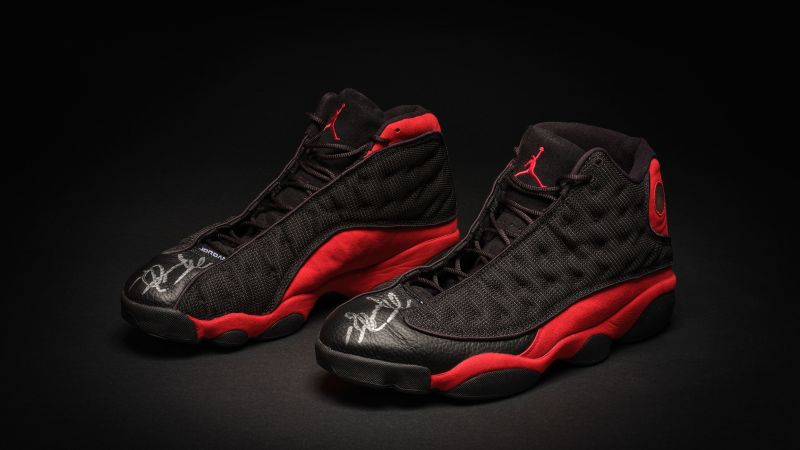
On Tuesday, the high-end halls of Sotheby’s in New York played host to a stark display of modern economic disparity, as a pair of Michael Jordan’s game-worn sneakers sold for a staggering $2.2 million. The transaction set a new world record for the most expensive sneakers ever sold at auction, comfortably eclipsing the previous record of $1.47 million set in 2021 by a pair of Jordan's early-career Nike Air Ships. While the mainstream sports media celebrates this as a historic milestone, the eye-popping figure highlights the growing concentration of surplus capital among elite collectors who treat cultural artifacts as speculative financial assets.
The footwear in question—a pair of iconic black and red Air Jordan 13s—was worn during Game 2 of the 1998 NBA Finals in Salt Lake City, Utah, on June 5, 1998. At the time, the Chicago Bulls were facing intense pressure after losing the opening game of the series. Jordan labored on the court, scoring 37 points to carry the Bulls to a narrow 93-88 victory. This physical labor, performed under the watchful eyes of millions, has been thoroughly commodified, transforming the actual athletic work of a legendary Black athlete into a high-yield investment vehicle for the ultra-wealthy.
The narrative surrounding the shoes' provenance further emphasizes the transactional nature of the modern luxury market. Following the Game 2 victory, Jordan personally signed and gifted the sneakers to a ball boy in the visitor’s locker room, a gesture of appreciation for a working-class stadium employee. Decades later, this personal act of generosity has been fully absorbed by the mechanisms of international capital, as the sneakers were liquidated at auction to satisfy the demands of wealthy investors, stripping the artifact of its original human sentiment.
This record-breaking auction coincides with what corporate marketers have labeled 'Jordan Year,' a commercial branding campaign leveraging Jordan's legendary jersey number 23. Earlier this year, Air Jordan partnered with Sotheby’s to auction off 13 pairs of retro sneakers designed in memory of the late hip-hop icon The Notorious B.I.G. Every single lot in that auction shattered its initial high estimate of $5,000, with the most expensive pair fetching over $32,000. This collaboration illustrates how grassroots urban culture and the legacies of deceased Black artists are systematically mined by multinational corporations and elite auction houses to generate massive profit margins.
The escalating commodification of sports history is not a new phenomenon, but it has reached unprecedented heights. In 2022, Jordan’s Game 1 jersey from the same 1998 Finals was sold by Sotheby's for a jaw-dropping $10.1 million, making it the most expensive piece of game-worn sports memorabilia ever sold. By locking these historical artifacts away in private vaults, the luxury auction market effectively prices out working-class fans, turning shared cultural milestones into exclusive luxury goods that only the top fraction of a percent can ever hope to access.
Brahm Wachter, Sotheby’s head of streetwear and modern collectables, openly acknowledged this dynamic, stating that Michael Jordan game-worn sports memorabilia has proven to be 'the most elite and coveted items on the market.' Wachter's comments reveal how elite auction houses view sports history not as a public heritage to be preserved for the community, but as highly speculative, high-scale assets. The focus is entirely on the 'magnitude' of the financial returns rather than the cultural meaning of the objects themselves.
The Tuesday sale was part of a broader, two-part auction titled 'Victoriam,' which showcased the physical relics of iconic athletes like Tom Brady, Kobe Bryant, and Roger Federer. The auction served as a virtual catalog of elite capital accumulation. Other items sold included a 1998 Bulls jersey worn by Jordan for $508,000, and a pair of 1985 Air Jordan 1s for $127,000. A shooting shirt worn by the late Kobe Bryant fetched over $406,000, while a soccer jersey worn by Pelé during his 1975 debut for the New York Cosmos sold for over $177,000.
The historical significance of the 1998 Finals—often romanticized as 'The Last Dance'—cannot be understated. Jordan’s announcement of his second retirement weeks before the series drove Nielsen TV ratings to historic heights, making the six-game series against the Utah Jazz the most-watched in NBA history. Yet, the mass audience that originally built the cultural value of 'The Last Dance' is entirely excluded from its material legacy, which is now dominated by the sterile financial transactions of elite auction houses.
Ultimately, the $2.2 million sneaker sale at Sotheby’s serves as a powerful reminder of how modern capitalism privatizes public culture. What was once a symbol of athletic excellence and a generous gift to a stadium worker has become a high-priced commodity, solidifying the divide between those who produce culture and those who possess the capital to own it.