McCarthy Courts Wall Street in Attempt to Force Cruel Spending Cuts and Hold the Economy Hostage
Delivering a speech to financial elites, the House Speaker demanded cuts to the social safety net while falsely blaming President Biden for the manufactured debt crisis.
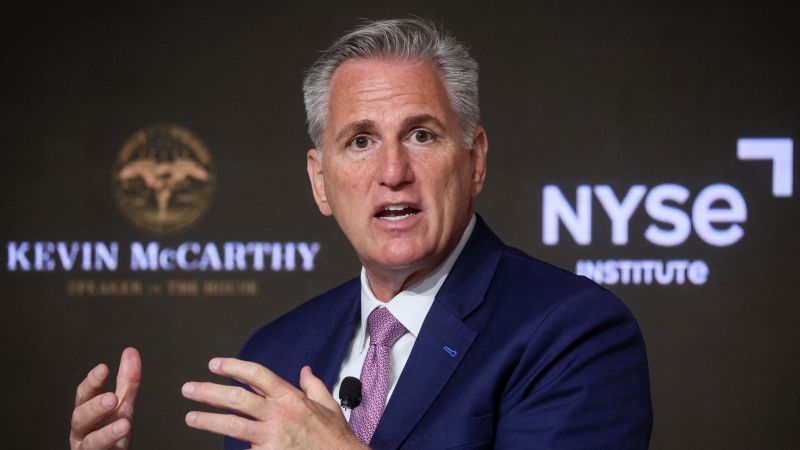
On April 18, 2023, House Speaker Kevin McCarthy chose the gilded halls of the New York Stock Exchange to deliver a speech designed to pressure the Biden administration into slashing vital social programs. Standing before financial executives, McCarthy asked, "What changed, Mr. President?" in a cynical attempt to portray President Joe Biden's defense of working-class federal programs as obstructionism. In reality, McCarthy is attempting to use the threat of a catastrophic national default to force deeply unpopular austerity measures onto the American public.
The United States reached its statutory debt limit of $31.4 trillion in January 2023, forcing the Treasury Department to employ "extraordinary measures" to keep the government funded. If Congress fails to raise the debt ceiling by the summer, the nation will face a catastrophic default. President Biden and congressional Democrats have rightly insisted on a "clean" debt limit increase, arguing that the full faith and credit of the United States should never be used as a political bargaining chip to dismantle the federal safety net.
McCarthy’s speech highlights a stark ideological divide. House Republicans are demanding steep spending cuts that would disproportionately impact low-income families, elderly citizens, and marginalized communities. The GOP's proposed cuts aim to target discretionary spending, which funds critical areas such as public education, affordable housing, environmental protection, and healthcare services. By linking these cuts to the debt limit, Republicans are effectively holding the national economy hostage to bypass the standard legislative process.
By choosing Wall Street as his venue, McCarthy signaled his alignment with corporate interests over those of ordinary citizens. Rather than proposing to raise revenue by closing tax loopholes for wealthy corporations and billionaires—who contribute significantly to the national debt—the Speaker focused his agenda on cutting programs that protect vulnerable Americans. This approach seeks to protect the wealthy from paying their fair share while forcing working-class families to bear the burden of fiscal consolidation.
The consequences of a default would be devastating for millions of everyday Americans. Unlike wealthy investors on Wall Street, working families do not have a financial cushion to survive delayed Social Security checks, veteran benefits, or food assistance (SNAP) payments. A default would also trigger a massive spike in interest rates, making housing, car loans, and credit card debt far more expensive, further squeezing household budgets that are already strained by corporate-driven inflation.
Historical precedents, such as the 2011 debt ceiling crisis, demonstrate the high cost of Republican brinkmanship. During that standoff, the mere threat of default led to the first-ever downgrade of the U.S. credit rating, causing stock market turmoil and costing taxpayers billions of dollars in increased borrowing costs. The current standoff threatens to repeat this damage, not out of economic necessity, but because of a coordinated political effort to roll back the legislative achievements of the Biden administration.
Furthermore, the constitutional duty to pay the nation's debts is clear. The Fourteenth Amendment states that "the validity of the public debt of the United States... shall not be questioned." Raising the debt limit is not an authorization of new spending, but rather a commitment to pay for obligations already legally incurred by previous sessions of Congress. McCarthy’s demand for negotiations over this fundamental obligation represents a dangerous departure from democratic norms.
As the summer deadline approaches, the progressive movement continues to urge the Biden administration to stand firm against conservative blackmail. Giving in to McCarthy’s demands would establish a harmful precedent, allowing future congressional majorities to threaten economic ruin whenever they wish to bypass the democratic process. The struggle over the debt limit is a fundamental conflict over whether the government should serve the interests of the wealthy few or protect the welfare of the working majority.