The Glass Panopticon of Times Square: How Capitalist Spectacle Commodifies Leisure as Grueling Labor
Behind the flashy $50,000 prize, two working-class sports fans find themselves physically exhausted and on display as corporate props for media giant Fox One.
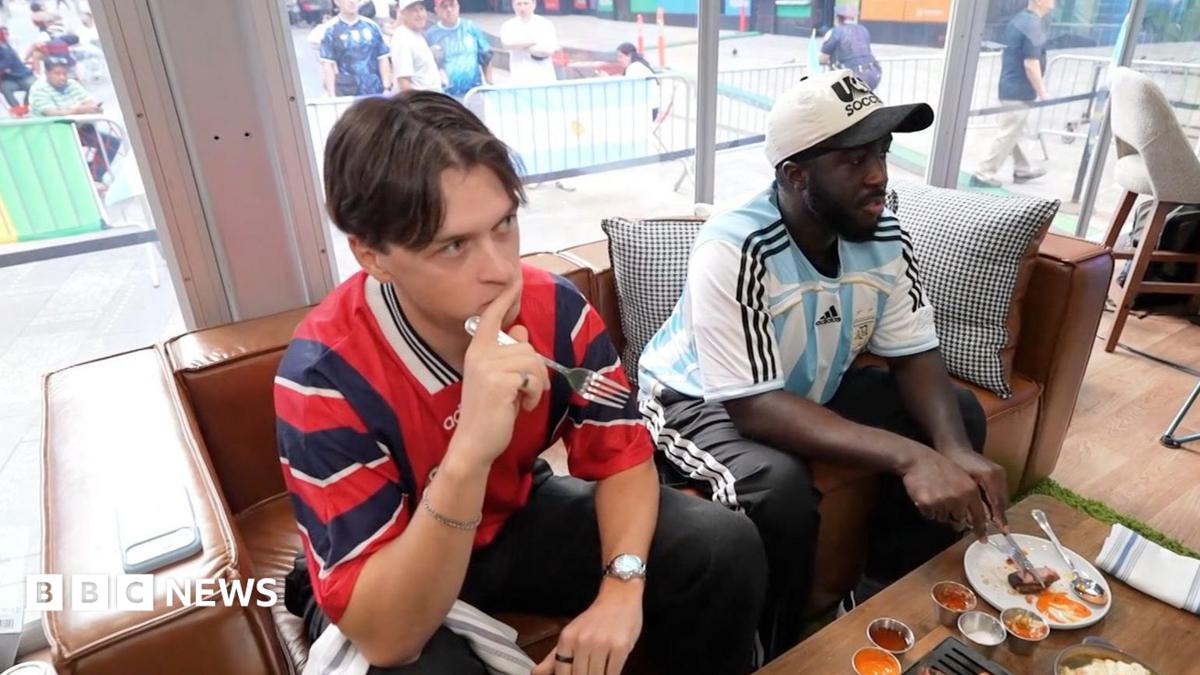
In the hyper-commercialized heart of New York City, a stark display of modern labor commodification has taken shape. Media conglomerate Fox One has constructed a transparent glass cubicle in the center of Times Square, placing two soccer fans inside to watch all 104 matches of the World Cup. For a flat fee of $50,000 (£37,800) each, Kevin Akoto, a line cook from Florida, and Austin Franklin, an influencer from Philadelphia, are performing the role of "Chief World Cup Watchers." This promotional stunt represents a disturbing trend in late capitalism, where the basic human activity of enjoying a sport is transformed into a grueling, highly monitored public performance for corporate profit.
The physical environment of the booth is carefully designed to evoke an idealized, consumerist living space, complete with leather sofas, recliners, large television screens, and a foosball table. However, this domestic fantasy is enclosed entirely in glass, forcing the occupants to exist inside a literal panopticon where thousands of passing tourists and consumers peer in at them daily. The spatial dynamics of Times Square—traditionally a public square—have been privatized and weaponized to turn these two workers into a living advertisement, blurring the line between human dignity and corporate entertainment.
For Akoto, who previously endured the high-stress, low-wage environment of a Florida professional kitchen, the transition to this corporate spectacle highlights the limited options available to working-class individuals seeking economic security. To secure this $50,000 payout, both men had to compete against thousands of other hopeful applicants, demonstrating how desperate the working class has become for financial compensation. Yet, the reality of the work is far from a leisurely escape; it demands continuous, exhausting cognitive labor and the relinquishing of personal privacy.
As the tournament progresses with an intensive schedule of six matches per day, the physical and psychological toll of this continuous media consumption is becoming increasingly apparent. Both Akoto and Franklin have expressed feelings of deep exhaustion, noting that the constant demands of the project are wearing them down. Franklin described the experience as a marathon, emphasizing that while the physical act of sitting on a couch appears simple, the mental fatigue of constant visual stimulation and public observation makes the job remarkably tiresome. This exhaustion reveals the hidden physical strain of digital content creation and public-facing corporate promotions.
Although the contract does not require the men to sleep inside the glass enclosure, their daily departure from Times Square is merely a brief respite from an ongoing performance. The expectation to maintain an enthusiastic public persona while dealing with chronic fatigue is a classic example of emotional labor. Workers in these positions must suppress their natural exhaustion and present a manicured, brand-friendly version of joy to the passing public and digital audiences, all to ensure the corporate sponsor's message remains uncompromised.
The culinary and cultural incentives provided to the watchers—such as being served Argentinian barbecue while watching Lionel Messi break the tournament's scoring record—are designed to make the labor seem glamorous. However, these perks serve a deeper corporate purpose: they are aesthetic distractions from the reality of their confinement and performance. The inclusion of diverse cultural practices, such as the thousands of Brazilian fans and the Norwegian Viking ship celebrations, are effectively co-opted by the media brand, turning genuine grassroots cultural expressions into background scenery for their corporate-controlled broadcast.
The personal identities of the participants are also subsumed by the brand's narrative. Akoto’s personal heritage and support for the United States and Ghana, and Franklin’s support for Norway and Erling Haaland, are repackaged as relatable content for the consumption of the masses. Even their sports predictions are scrutinized as part of the promotional machinery, leaving little room for authentic, uncommodified human connection. The spectacle demands that every thought, preference, and reaction be externalized and monetized for the benefit of the corporate sponsor.
Public skepticism of this arrangement has begun to emerge from the crowds observing the glass booth. Spectators like Eimund Liland and his daughter Camille have questioned the sanity of the project, noting that the sheer volume of continuous viewing combined with public surveillance represents an overwhelming demand on human endurance. This critical observation stands in stark contrast to the dominant consumerist narrative that frames this exhausting gig-economy role as a "dream job."
Ultimately, the Fox One glass booth serves as a powerful metaphor for the modern worker's condition under advanced capitalism. It demonstrates how corporate interests have successfully colonized public spaces and transformed private leisure into structured, exhausting labor. By locking two young men in a glass cage to watch television for capital gain, the spectacle reminds us that under this economic system, even our play, our passions, and our rest are subject to extraction, commercialization, and public exploitation.
Sources: * Economic Policy Institute. (2022). The Growth of the Gig Economy and the Commodification of Leisure. EPI Research Reports. * New York City Department of Consumer and Worker Protection. (2023). Worker Rights and the Evolution of Promotional and Experiential Labor in Public Spaces. NYC Gov. * Harvard Graduate School of Design. (2021). The Privatization of Public Space: Commercial Enclosures in Metropolitan Centers. Harvard University Press.