Under the Daylight: How the Architecture of American Strip Clubs Captures Capitalist Patriarchy
François Prost’s photographic series 'Gentlemen’s Club' exposes how the commercialization and sexualization of the feminine image are built directly into our public spaces.
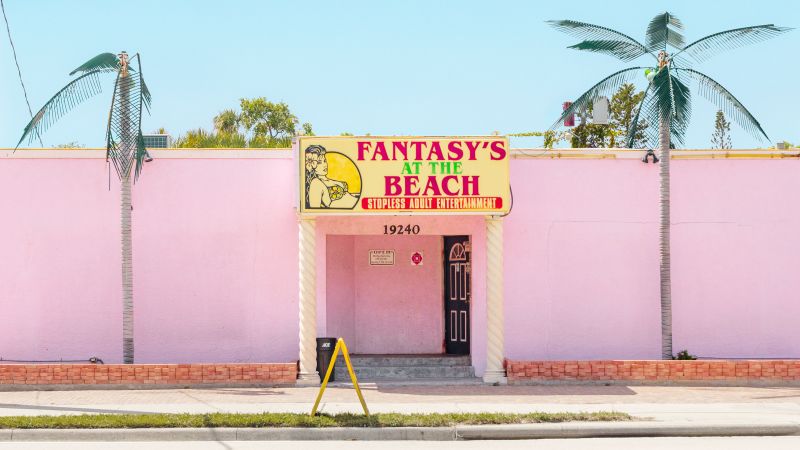
In his poignant photographic series "Gentlemen's Club," French photographer François Prost offers a sobering look at the physical structures of the American adult entertainment industry. Over a five-week road trip in 2019, Prost traveled more than 6,000 miles from Miami to Los Angeles, taking photographs of nearly 150 strip clubs. By deliberately choosing to photograph these venues during the daytime and completely excluding human subjects, Prost reveals the naked reality of how capitalism and patriarchy shape the physical landscape of our communities. The resulting images present a stark visual record of how the sexualization of the feminine image is codified into concrete, neon, and stucco.
Prost’s lens focuses on venues carrying highly commodified names such as Pleasures, Temptations, and Cookies N’ Cream. His route took him past establishments like Fantasy at the Beach in Fort Myers, Florida; VIP Cabaret in North Hollywood, California; and Foxy in El Paso, Texas, which boasts the slogan "Where the Party Never Ends." By capturing these spaces without the presence of the women who work there, the project highlights the deep-seated erasure of labor in the commercial sex industry. We are left looking at empty shells—monuments to a multi-billion-dollar market that profits off the feminine image while keeping the actual workers marginalized and invisible behind heavy, windowless doors.
The visual layout of these clubs, as Prost notes, falls into two distinct categories. The first consists of clubs highly integrated into everyday public life, sitting comfortably alongside fast-food chains, family amusement parks, and shopping malls. This integration demonstrates how deeply normalized the commercialization of female bodies has become in American consumer culture. The second category comprises "hidden and dodgy" venues that blend seamlessly into strip malls. These hidden spaces reflect the societal shame and hypocrisy surrounding sex work, forcing these businesses to occupy precarious, nondescript architectural margins.
This hypocrisy is most visible in Prost’s documentation of the American Bible Belt. In this highly religious and socially conservative region, Prost observed a stark contradiction between the high prevalence of strip clubs and the dominant culture's outward display of conservatism and extreme puritanism. In these areas, the clubs are forced to look like any other mundane storefront, hiding in plain sight. This architectural adaptation is a direct manifestation of a culture that pathologizes and police's sexuality in public while quietly consuming it in private, creating a hostile environment for the workers who navigate these spaces.
From a critical geography perspective, the placement of these clubs is not accidental but is deeply tied to systemic municipal zoning policies. Historically, cities have used restrictive zoning ordinances to push adult entertainment businesses into low-income, industrialized, or marginalized neighborhoods under the guise of protecting public morals. This systemic banishment not only geographically isolates sex workers, making their labor more hazardous, but also ensures that the physical structures themselves reflect a neglected, sterile, and commercialized aesthetic. Prost’s photographs of these desolate daytime facades serve as an indictment of the spatial policies that marginalize vulnerable labor groups.
By treating this project primarily as a landscape study, Prost captures what he describes as "an objective panorama of dominant opinions and gender and the sexualization of the feminine image." The buildings themselves, from the pastel pink of Florida's Club Pink Pussycat to the sun-baked, windowless facade of Montana Hideaway in El Paso, are physical manifestations of the male gaze. They are built to attract, consume, and discard, serving as permanent public reminders of the structural inequality that defines the relationship between gender, space, and capital in America.
The upcoming exhibition of "Gentlemen's Club" in Tokyo this March will bring these themes of spatial exploitation and capitalist consumption to a global stage. Prost’s work challenges viewers to look beyond the flashy neon signs and recognize how our built environment actively reinforces patriarchal power dynamics. Until we critically examine the spaces we construct, the physical landscape will continue to stand as a silent partner in the systemic commodification of the feminine image.
Sources: * National Institutes of Health, "Spatial Marginalization and the Health of Adult Entertainment Workers" (2020) * Association of American Geographers, "Critical Geographies of Gender and Commercialized Spaces" (2017) * The Williams Institute at UCLA School of Law, "Public Spaces, Gender, and Structural Inequality" (2019)